Table of Contents
ToggleA patio pool transforms your backyard from a blank canvas into a personal resort. Whether you’re working with a tiny urban lot or sprawling suburban acreage, there’s a pool design that fits your space and budget. This guide walks you through seven distinct patio pool ideas, from compact plunge pools to luxurious infinity edges, giving you the practical framework to plan your project. You’ll learn what’s DIY-friendly, what requires permits and professionals, and how to pair your pool with landscaping, lighting, and hardscaping for maximum impact. Let’s build your backyard oasis.
Key Takeaways
- Patio pool ideas range from budget-friendly above-ground units ($2,000–$4,000) to luxury infinity pools ($50,000+), making backyard pools accessible regardless of space or budget constraints.
- Compact pool designs like plunge pools, spools, and cocktail pools are ideal for small patios and urban lots, with installation costs between $5,000–$15,000 and completion times of 2–4 weeks.
- DIY-friendly options include above-ground steel-frame pools and modular fiberglass shells, though structural and electrical work always requires licensed professionals to ensure safety and code compliance.
- Pairing your pool with strategic landscaping, quality decking materials, and thoughtful lighting design transforms it into a resort-like outdoor living space that boosts property value.
- Infinity edge pools demand precise engineering and professional installation but can be approximated with waterline tile treatments at roughly 40% lower cost if budget is a concern.
- Water chemistry and maintenance vary by pool type—above-ground pools cost $30–$60 monthly, while spas require more frequent testing (2–3 times weekly) and bromine treatment due to smaller water volume.
Compact Pool Designs for Small Patios
Not every homeowner has a sprawling lot. A compact pool, typically 12 feet by 15 feet or smaller, works brilliantly for tight urban patios, narrow side yards, or homes where space commands premium value.
Plunge pools are the starter option. These shallow, short-length basins (6–8 feet long, 4–6 feet deep) cost significantly less to install than full-size pools and demand minimal ongoing maintenance. Think of them as high-end soaking tubs for your yard: they’re perfect for cooling off on hot days without requiring lap space. A concrete shell costs around $8,000–$15,000 depending on finishes and regional labor rates.
Spool designs, a hybrid between a spa and pool, pack temperature control and jets into a smaller footprint (8 feet by 10 feet is common). This approach gives you warm water for winter use and the option to cool it down in summer. Fiberglass spools run $5,000–$12,000 installed, with lower chemical costs than traditional hot tubs because they’re chlorinated like regular pools.
For truly minimal square footage, a cocktail pool fits into a 6-foot-by-8-foot corner nook. It won’t accommodate swimming laps, but it’ll handle a few lounging friends and delivers serious visual impact without breaking the budget or local setback regulations. Consider raised walls or built-in benches around the perimeter to maximize utility in confined spaces. Most compact pools require basic permits, check your local jurisdiction, but installation typically takes 2–4 weeks versus 6–8 weeks for larger models.
Luxury Infinity Pool Features
An infinity edge (or vanishing edge) creates the illusion that water flows endlessly into the horizon. It’s a statement piece that photographs beautifully and commands attention on any patio. The visual trick works by dropping one edge below sight line and pumping water from a hidden basin back into the main pool.
Infinity pools demand precise grading and a skilled contractor: this isn’t a DIY undertaking. The basin behind the edge, called the catch basin, must slope perfectly to recirculate water without spilling or leaving dry patches. Costs typically run $50,000–$100,000+ for a residential installation, depending on size, materials, and whether you’re incorporating it into a custom spa or resort-style complex.
Negative-edge features work well on sloped properties where you can leverage the natural terrain. A pool at the top of a hill with water cascading into a lower basin below creates drama and maximizes property views. This approach is especially popular in Mediterranean, modern, and contemporary designs.
For a budget-conscious take, you can use waterline tile or stone coping that creates a clean, minimalist edge without the engineering complexity of a true vanishing edge. The visual effect is sleek and refined while reducing construction costs by roughly 40%. Pair infinity pools with automated systems that monitor water level and pump flow, essential because any air leak breaks the optical effect. These require licensed electricians and plumbers to install safely.
Budget-Friendly DIY Pool Solutions
Not every backyard pool requires a contractor and a five-figure budget. Several approaches let you build or install pools yourself, though honest assessment of your skill level and time commitment is critical.
Above-ground steel-frame pools are the most DIY-friendly option. A 20-foot-by-12-foot unit costs $2,000–$4,000 and takes a dedicated weekend (or two) to assemble. You’ll need a level, compacted subbase (4–6 inches of sand), basic tools, and a helper to wrangle the frame panels. Home Depot and Lowe’s stock complete kits with pumps, filters, and liners. Water chemistry still requires attention, chlorine, pH strips, and a test kit are non-negotiable, but monthly costs run $30–$60. These pools won’t last 20+ years like gunite shells, but 8–10 years is realistic with proper care.
Modular concrete pools (also called prefab fiberglass shells) arrive at your property ready-installed, you just dig the hole and backfill. They’re cheaper than custom concrete (roughly $15,000–$30,000) and faster (2–3 weeks), making them a solid middle ground. You’ll still need a licensed excavator and plumber for the pit and plumbing work: the structural aspects aren’t DIY territory.
Kiddie pool upgrades sound humble, but creative staging transforms them into focal points. Large 4-foot-diameter basins ($50–$150) work for small children, but you can also dress them up with decking, surrounding planters, and proper drainage. Home Depot Pool Supplies stocks filters and basic chemical kits that reduce your hands-on maintenance. Be honest about longevity: these are seasonal solutions, not permanent installations, but they’re perfect for testing whether a full pool fits your lifestyle before committing to a $30,000+ build.
Spa and Hot Tub Integration
Pairing a spa or hot tub with your patio pool extends the season and adds year-round utility. A detached spa next to the pool lets guests transition from cool water to warm jets, a luxury touch that feels resort-like without doubling your footprint.
Integrated spas sit at one corner of the pool and share the same filtration and plumbing system. This approach saves on installation labor and ongoing pump running costs. A 6-foot-by-4-foot spa attached to a 15-foot-by-30-foot pool adds roughly $8,000–$12,000 to the build, depending on whether you’re adding jets, lighting, and temperature controls.
Standalone hot tubs offer flexibility: you can position them away from the main pool (useful if your patio layout is irregular) and heat them independently. A quality fiberglass tub holds 300–500 gallons and costs $3,000–$8,000, with heating and electrical work another $2,000–$5,000. Gas heaters are faster but costlier to operate than electric models. Many homeowners prefer electric for smaller tubs because fuel bills don’t spiral in mild climates.
Chemical balance becomes more critical with spas because the water volume is smaller and bather load per gallon is higher. Bromine (more stable at high temps than chlorine) is the standard choice. You’ll test more frequently, ideally 2–3 times weekly during heavy use, and drain completely every 3–4 months to prevent buildup. Pool Maintenance Miami offers region-specific guidance, but the fundamentals hold across climates: consistent testing prevents algae, scale, and corrosion.
Landscape and Hardscape Pairing
A pool without thoughtful landscaping looks like a hole in the ground. Strategic plant selection, decking materials, and shade structures complete the picture and boost your property’s resale value.
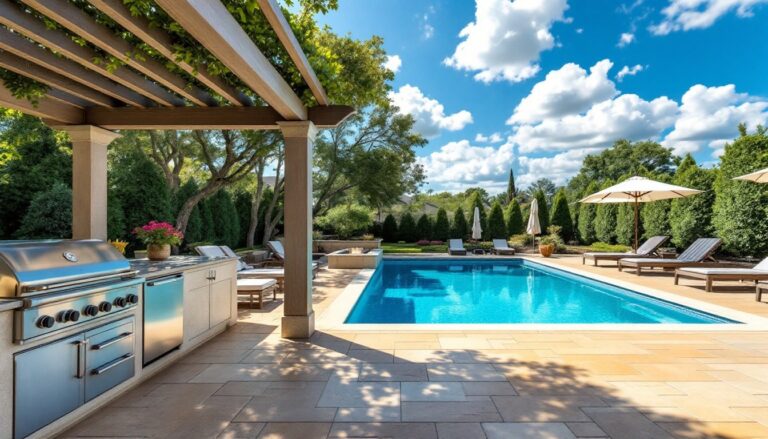
Decking choices set the tone. Composite decking ($12–$25 per square foot installed) never rots and requires zero staining, making it maintenance-free, ideal for wet environments. Natural stone (travertine, limestone, slate) costs more ($15–$30+ per square foot) but stays cooler underfoot than concrete in full sun. Pressure-treated wood is budget-friendly ($5–$12 per square foot) but demands annual sealing and has a 10–15-year lifespan before rot or warping sets in.
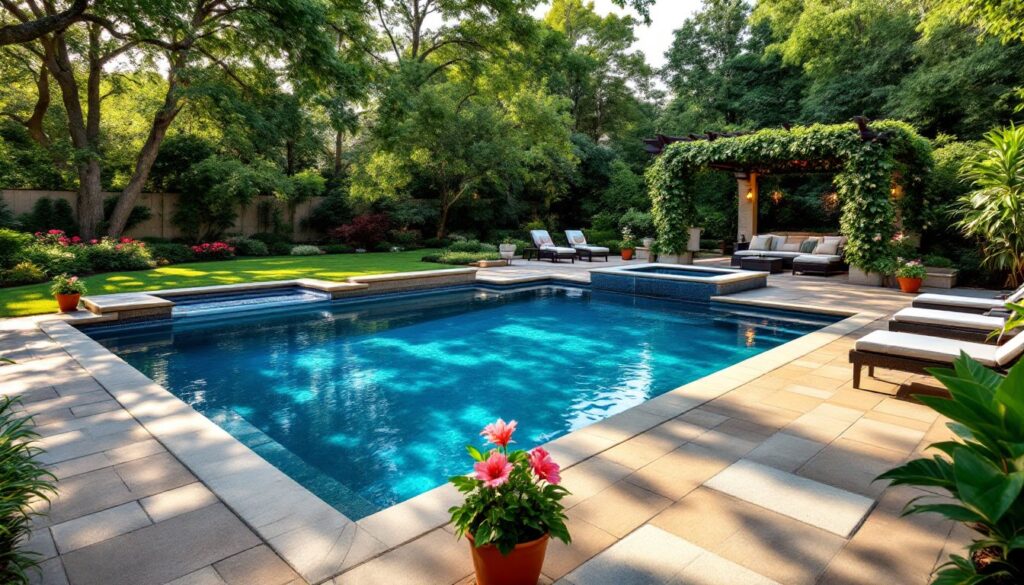
Plant layering around the pool creates visual interest and privacy. Fast-growing evergreens (arborvitae, cypress) form quick screens on property lines: deciduous trees (crape myrtle, Japanese maple) provide summer shade without blocking winter sun. Tropical plants (hibiscus, bougainvillea) suit warm climates, while colder zones thrive with ornamental grasses and flowering shrubs. Avoid dropping-leaf trees (cottonwoods, ash) immediately beside the pool, leaf cleanup becomes a seasonal nightmare.
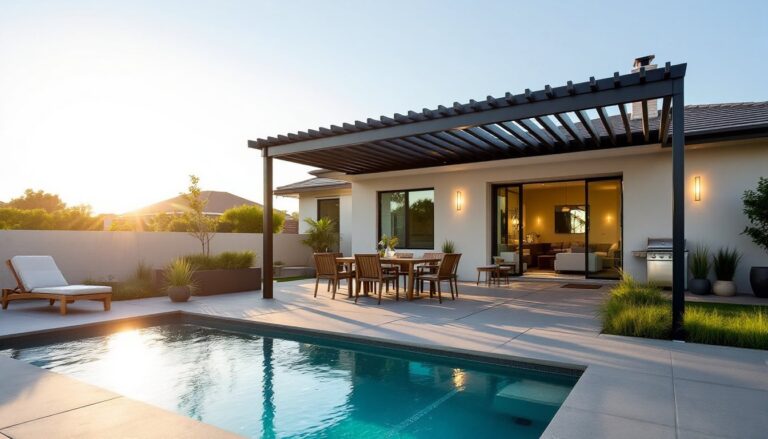
Shade structures like pergolas, umbrellas, or retractable awnings ($1,500–$5,000+) protect loungers from UV exposure and reduce deck heat. A pergola covered in climbing vines or shade cloth creates a natural cooling effect. Gardening guides from reliable sources detail hardiness zones and seasonal maintenance for your region. Hardscape pathways connecting your house to the pool create safe, slip-free circulation even when guests are wet. Natural stone or permeable pavers prevent water pooling and reduce your overall drainage load.
Lighting and Ambiance Enhancements
Evening lighting transforms a patio pool from daytime amenity into nighttime showpiece. Proper illumination also improves safety for barefoot movement and night swimming.
Underwater LED lights ($1,500–$3,000 for a complete system) mount into the pool walls or floor and can cycle through colors or stay fixed in white. RGB (red-green-blue) systems let you set mood, cool whites for functional lighting, warm ambers for entertaining, or dynamic colors for special events. LEDs consume roughly 80% less energy than older halogen bulbs and last 25,000+ hours, making them the only practical choice for new builds.
Deck and pathway lighting ($50–$150 per fixture installed) uses solar stake lights, recessed ground fixtures, or low-voltage rail lights along stairs and edges. Solar options eliminate trenching and electrical work but charge slowly on cloudy days: hardwired low-voltage (12V) systems are more reliable and dimmer-compatible. Space deck lights 3–4 feet apart for even illumination without bright spots.
Landscape accent lighting highlights specimen trees, water features, or architectural elements around the pool. Uplighting a mature shade tree creates drama: soft downlighting through pergolas casts flattering shadows. Avoid over-lighting: restrained illumination reads as sophisticated, while every surface lit feels like a parking lot.
All electrical work, especially anything poolside, requires a licensed electrician and compliance with NEC Article 680 (electrical safety for swimming pools). Ground fault circuit interrupters (GFCIs) are mandatory on all circuits within 6 feet of the pool edge. Permits are non-negotiable here: code violations create shock hazard and void homeowner’s insurance. Budget $1,500–$3,000 for a licensed install of a complete lighting scheme including hardwired circuits and proper grounding.
Conclusion
Your patio pool doesn’t have to be a luxury you only read about. Whether you’re installing a compact plunge pool on a tight urban lot, building a DIY above-ground structure, or splurging on an infinity edge, the right design matches your space, budget, and lifestyle. Pair your pool with thoughtful landscaping, durable decking, and evening lighting to create an outdoor room you’ll use year-round. Start with an honest assessment of your property’s grading, local codes, and your DIY comfort level. When in doubt, especially with electrical, permits, or structural work, hire a licensed pro. Your backyard oasis is worth getting right the first time.