Table of Contents
ToggleA sloped backyard doesn’t have to be a dealbreaker for pool dreams. Many homeowners assume steep or uneven terrain makes a pool impossible, but the reality is far different. Modern pool design has evolved to embrace challenging landscapes, turning slopes into stunning architectural features rather than obstacles. Whether your yard drops 10 feet across 30 feet or slopes more gradually, there’s a practical solution that transforms that grade change into something both functional and beautiful. This guide covers seven creative approaches that work with your land’s natural topology, help you understand the trade-offs of each design, and keep costs realistic for DIY-adjacent planning.
Key Takeaways
- Sloped backyard pool ideas are achievable through modern design solutions like terraced pools, infinity edges, and elevated platforms that transform challenging terrain into stunning architectural features.
- Terraced pool designs with retaining walls are ideal for steep slopes, typically costing $15,000–$35,000 and requiring licensed engineering and building permits for walls over 4 feet high.
- Infinity edge pools on hillsides create a mesmerizing visual effect by cascading water into a catch basin, working best on 15–30 degree slopes and costing $25,000–$45,000 installed.
- Budget-conscious alternatives like above-ground pools ($3,000–$8,000) and prefab fiberglass shells ($12,000–$25,000) provide practical sloped backyard pool options without extensive excavation.
- Proper decking, landscaping, and drainage management are critical to prevent erosion and maintain pool stability on sloped properties, with costs ranging from $2,000–$5,000 for slope-appropriate plantings.
- Always consult a licensed pool contractor or engineer before starting any sloped backyard pool project, as local building codes, frost lines, and soil conditions vary significantly by region.
Terraced Pool Designs for Steep Slopes
Multi-Level Pools with Retaining Walls
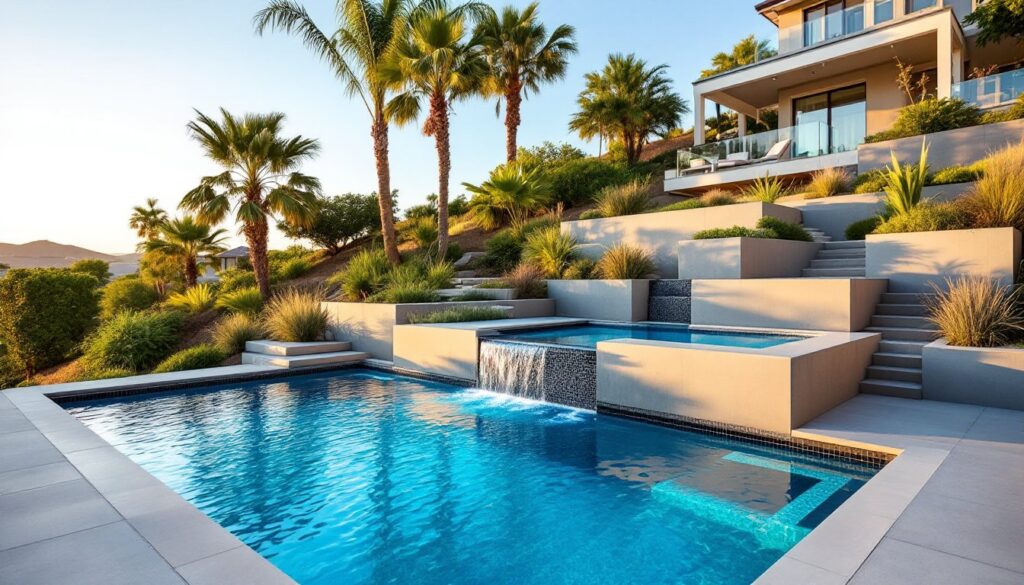
Terracing is one of the most popular solutions for significant slopes because it works with gravity rather than against it. The basic concept: build retaining walls at key elevation points to create flat platforms, then install pool sections on those platforms.
A two-level setup is common, a deeper swimming area at the lower elevation and a shallow recreation pool, spa, or sunbathing platform above. This approach offers several practical advantages. You’re not fighting the slope: you’re using it as structure. Retaining walls (typically 8–16 inches thick concrete, steel, or timber) handle the soil pressure, and proper drainage behind them prevents water buildup that causes failure.
The math matters here. Typical residential pools are 15–30 feet wide and 20–50 feet long, with 3–8 feet of water depth. On a slope, you’re essentially creating two smaller pools instead of one large one, which affects volume and equipment needs. A lower pool at 4 feet deep and 300 square feet requires roughly 900 gallons of fill and circulation for every inch of additional depth, a two-level design might need two separate pump-and-filter systems or one oversized system with a valve configuration.
Permits and engineering are non-negotiable here. Retaining walls over 4 feet high typically require a licensed engineer’s design and a building permit in most jurisdictions (codes vary by location). Excavation, backfill, and drainage must follow local IRC (International Residential Code) standards. Hire a pool contractor or engineer first: this isn’t a “figure it out as you go” project. The cost typically ranges $15,000–$35,000 for the terracing alone, depending on soil composition, wall height, and local labor rates.
Infinity Edge Pools on Hillside Properties
An infinity pool, where water spills over one edge into a catch basin below, creates the illusion that the pool extends into the horizon. On a hillside, this design is both practical and visually stunning. Instead of fighting the slope with walls, you harness the natural grade change as the pool’s defining feature.
The mechanics: the pool’s edge sits at a slightly higher elevation than the catch basin beneath. Water continuously overflows that edge (usually 2–4 inches per minute), cascades into the basin below, and recirculates via pump back into the main pool. The effect is mesmerizing, and it transforms wasted slope space into a focal point.
This design works best on slopes of 15–30 degrees where you have 6–15 feet of elevation change across the pool’s width. Steeper slopes complicate the catch basin design: gentler slopes make the overflow less dramatic. A typical infinity edge setup costs $25,000–$45,000, roughly 40–50% more than a standard pool of the same size because of the extra plumbing, circulation, and structural work.
Design considerations: the catch basin must be waterproofed and sized to handle the full pump flow (typically 3,000–6,000 gallons per hour for residential pools). You’ll need redundant drains to prevent overflow if the pump fails. Most jurisdictions require 1-inch drainage at minimum from the basin to a sump or storm system. Pool maintenance and proper. The overflow edge itself is typically finished with architectural concrete, natural stone, or decorative tile, materials that hide the water-collection mechanics while complementing the landscape.
Elevated and Wraparound Pool Layouts
Not every slope calls for building into the hillside. Sometimes the smarter play is to build up and around the grade change with an elevated deck or a pool platform that wraps the contours of the yard.
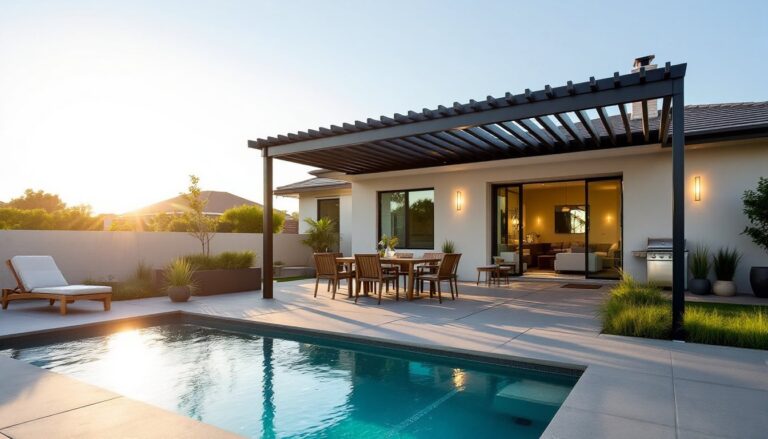
An elevated pool sits on a structural platform, typically pressure-treated wood pilings, concrete piers, or a steel frame, that raises the entire pool 2–4 feet above natural grade. This approach is ideal for moderate slopes (5–12 degrees) where full terracing feels overkill. The platform bridges the elevation change, and you get a stunning visual: a pool that appears to float above the landscape.
Wraparound designs follow the natural contours rather than imposing a rigid rectangle. Picture a pool that curves around a slope, with the deck stepping down in sections. This requires custom concrete forming and is more expensive than a standard rectangular pool, but it looks intentional and works with existing trees or views.
The upside: minimal excavation and fewer drainage complications compared to deep retaining walls. You’re building on the slope, not into it.
The downside: you need solid structural design. Frost lines (how deep soil freezes in winter) vary by region, typically 12–48 inches below grade. Pilings must extend below frost line to prevent heave. Steel or pressure-treated lumber supports typically cost $8,000–$15,000 for a 400-square-foot platform. Building codes require engineer stamps and permits. For a full wraparound layout, expect $30,000–$50,000 depending on complexity and materials.
Decking and Landscaping Solutions for Sloped Yards
The area around the pool often matters as much as the pool itself, especially on slopes. Proper decking and landscaping prevent erosion, improve safety, and tie the pool into the yard’s existing grade.
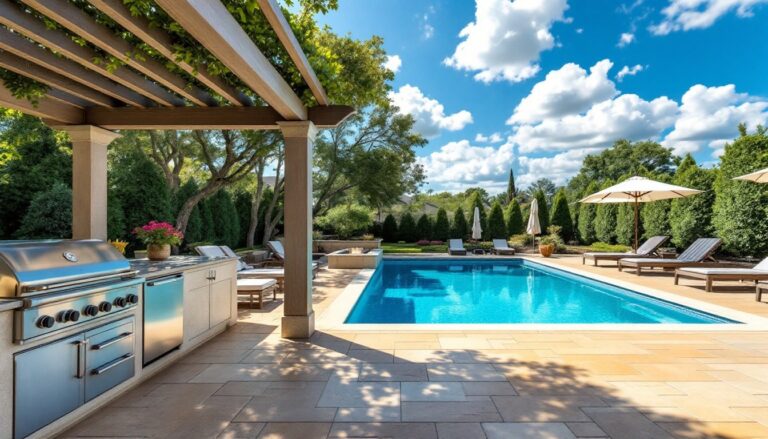
Decking on slopes: Standard pool decks are 10–12 feet wide and slope slightly (typically 1/8 inch per foot) for drainage. On uneven terrain, stepped or tiered decking is more practical than a single flat surface. Composite decking or pressure-treated lumber work well: natural stone (flagstone, slate, or bluestone) requires more careful installation because uneven ground makes it harder to achieve a solid, non-slip surface.
Steps or transitions between deck levels should be at least 7 inches tread depth and 8 inches rise (meeting code minimums, check local building standards). Handrails are required by code on slopes steeper than 1:12 ratio, so plan for those early.
Landscaping and drainage: On a slope, water doesn’t sit, it flows downhill. Without proper management, it erodes soil, destabilizes the pool’s foundation, and creates muddy, unsafe conditions. Install hardscape solutions like retaining. Drains or French drains should channel water away from the pool structure. Swales (shallow ditches) or permeable hardscape redirect surface water.
Planting on slopes requires shallow-rooted vegetation or erosion-control fabrics to hold soil in place. Deep-rooted trees can damage pool structures if roots grow beneath concrete or deck pilings. Slope-appropriate plantings (ornamental grasses, groundcovers, and shrubs) cost $2,000–$5,000 for a typical backyard installation and add both aesthetics and stability.
Budget-Friendly Alternatives and Material Choices
Not everyone’s budget supports a $30,000+ in-ground terraced pool. Several alternatives exist for sloped yards that cost far less while still delivering a backyard oasis.
Above-ground pools: A quality steel-walled above-ground pool (typically 12–24 feet in diameter, 3.5–5 feet deep) costs $3,000–$8,000 installed. On a slope, you still need a level foundation, you’ll excavate and compact the lower side slightly to create a 3–6 inch level platform. These pools don’t look as permanent or custom as in-ground options, but they’re modular, removable, and require no permit in most areas if kept under 24 inches deep and 200 gallons. Installation is a weekend project for a handy homeowner and a helper.
Prefab pools and shells: Fiberglass shell pools come in standard shapes and sizes (15–30 feet long) and are set into excavated holes on level ground. They’re faster to install than concrete (typically 2–3 weeks total) and cost $12,000–$25,000 depending on size. Because they’re rigid, they’re not as customizable as concrete, but they require less ongoing maintenance.
Composite or modular deck pools: Some newer modular systems combine deck and pool in one unit. Companies offer 16–20 foot pools with integrated decking for $8,000–$15,000. They’re not ideal for steep slopes (they still need a level base), but they’re a middle ground between above-ground simplicity and full terracing complexity.
Material choices: Concrete for pool shells offers maximum customization but highest cost and longest construction time. Fiberglass is faster and lower-maintenance. For decking, pressure-treated lumber is the cheapest (roughly $15–$25 per square foot installed), composite decking is mid-range ($25–$40/sf), and natural stone is premium ($40–$80/sf or more). Your slope and budget should drive the material selection, a heavily sloped yard might justify investing in stone or composite for durability and aesthetics, while a gentle slope and tight budget might favor composite platforms over deep retaining walls.
Talk to local pool contractors about what works for your specific grade, soil type, and drainage conditions. Checking with resources like Better Homes & Gardens or The Spruce can provide additional design inspiration before you commit to a contractor.
Conclusion
A sloped backyard isn’t a limitation, it’s an opportunity for creative design. Whether you choose terraced pools, infinity edges, elevated platforms, or more budget-conscious alternatives like above-ground setups, the key is matching the design to your slope’s severity, your budget, and your building code requirements. Always start with a consultation from a licensed pool contractor or engineer: skipping this step costs far more in mistakes. With the right approach, your challenging terrain becomes your pool’s standout feature.